
Welcome

Faculty of Multidisciplinary Studies

Transforming Education Through Collaboration

As societies contemplate contemporary realities and ways of improving the quality of lives, it happens that traditional structures of governance and institutions also explore competing options for effective interventions. Emerging socioeconomic realities and technological advancements have created new possibilities and pressures as well. However, the interrelatedness of societal existential challenges and the imperative of preserving social order encourages cross-disciplinary scholarly inquiries and orientation. Consequently, a shared dedication to interdisciplinarity in solution–driven inquiries on contemporary and existential issues foregrounds a pioneering Faculty of Multidisciplinary Studies at the University of Ibadan, Nigeria.


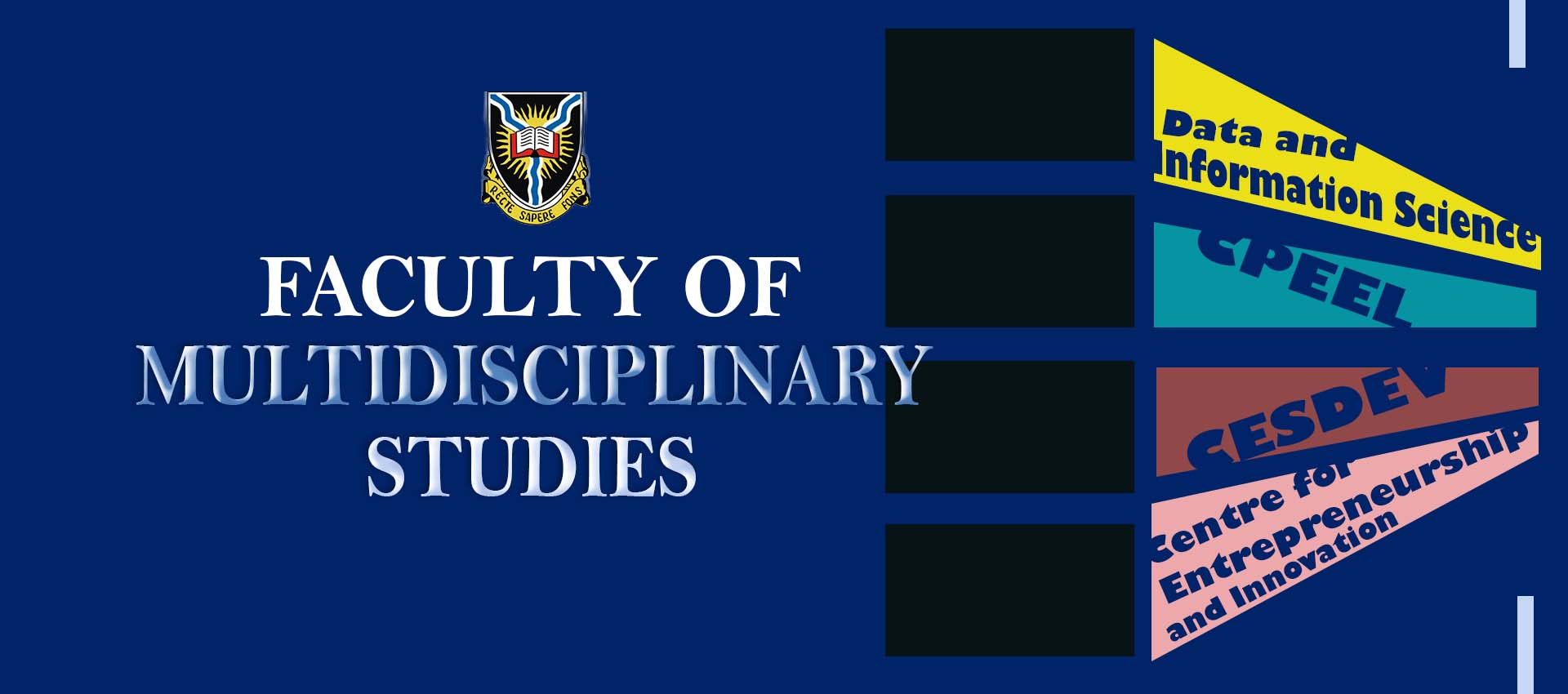
FMS was thrust with the mandate of coordinating through the departments, the postgraduate studies for the awards of degrees in various programmes offered across four interdisciplinary research Centers of Excellence and one institute: Center for Petroleum, Energy Economics and Law (CPEEL); Center for Sustainable Development (CESDEV); African Regional Center in Information Science (ARCIS); Center for Bioethics and Medical Humanities (CBMH); and the Institute for Peace and Strategic Studies (IPSS).


With a commitment to collaborative scholarship, the faculty continues to explore new frontiers of intellectual engagements that enrich teaching, research and community service for sustainable solutions. Thank you, and once again, welcome.


Professor P. C. Obutte (Dean)

LL. B (Ibadan), B.L, LL. M (Ife), Cert. Antitrust (Fordham), Sp.LL. M, LL. D (Oslo).
Email: pc.obutte@ui.edu.ng, pcobutte@gmail.com
Phone: +2348082031221
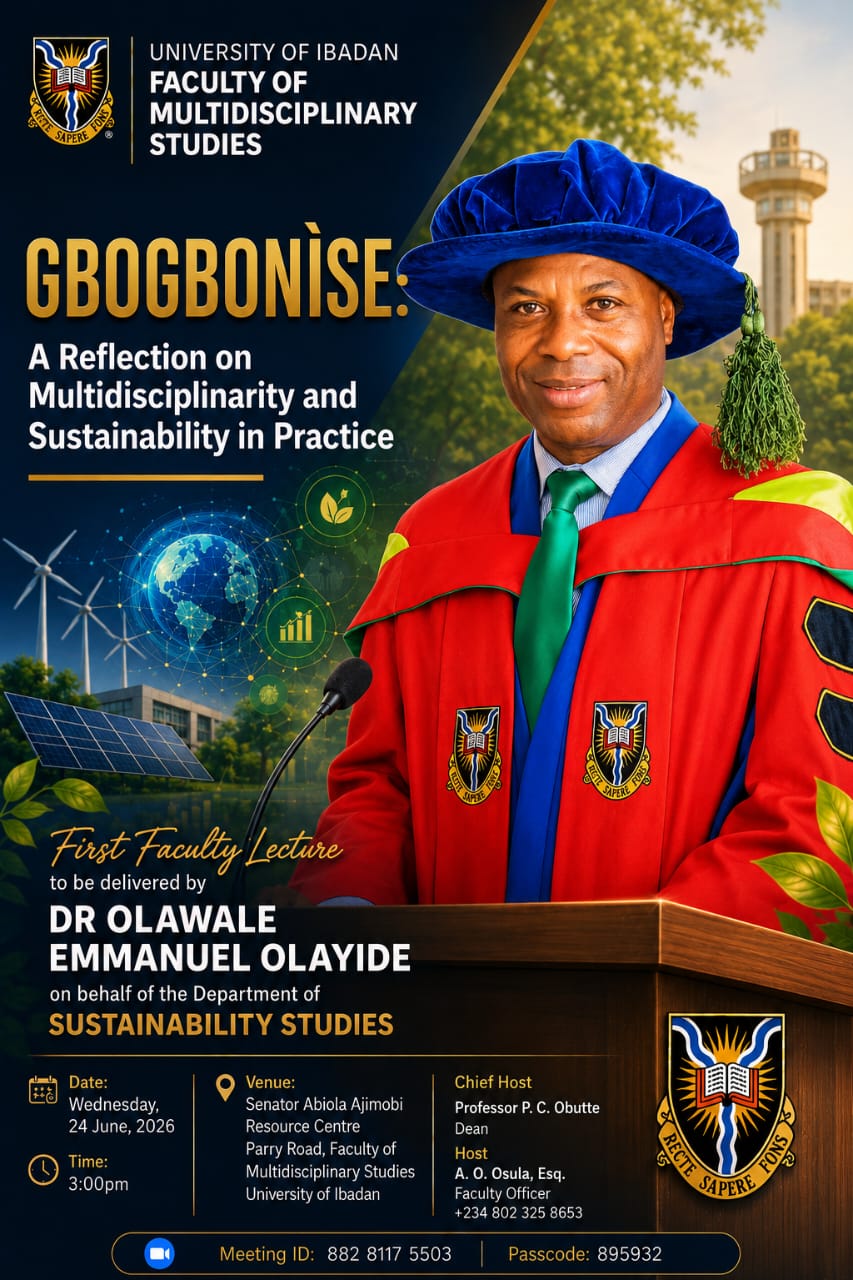
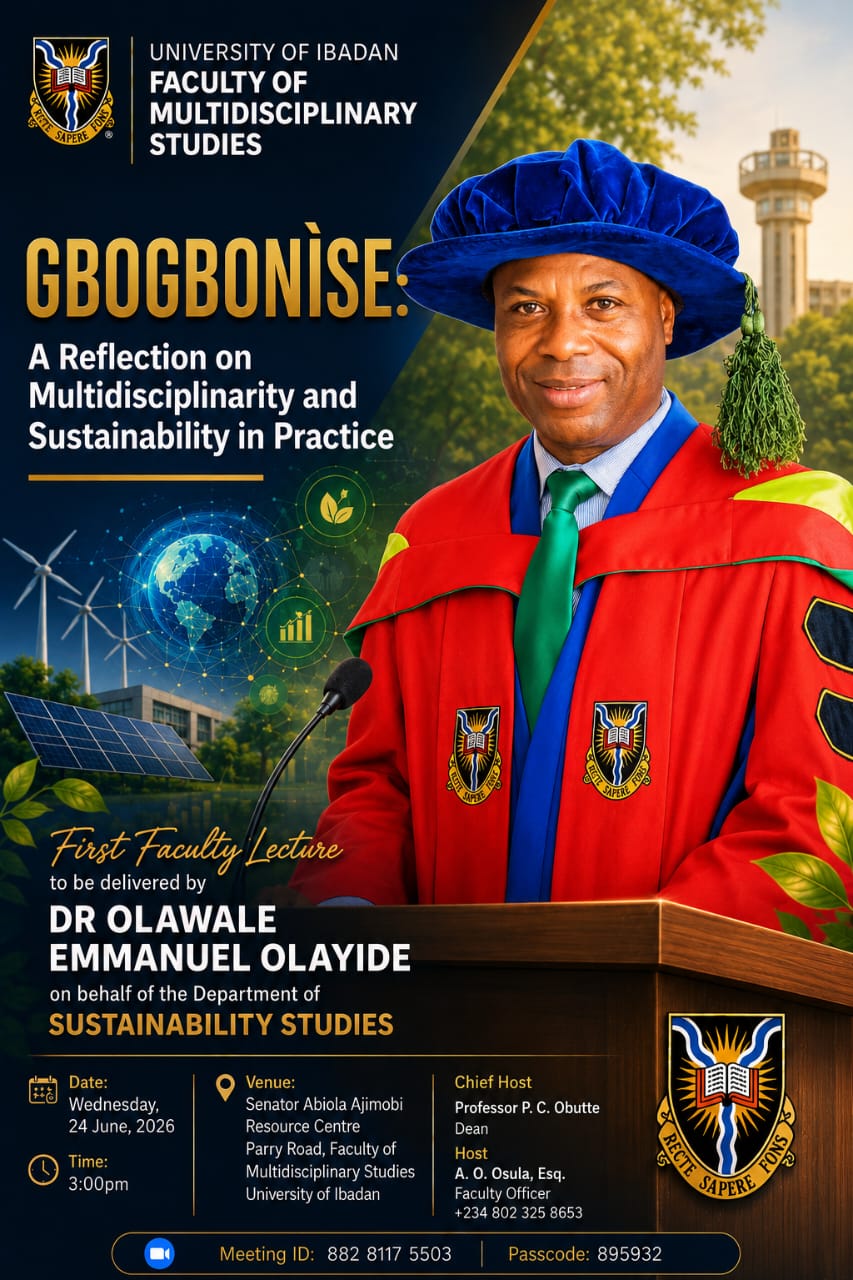
First Faculty Lecture

to be delivered by Dr Olawale Emmanuel Olayide 

TITLE: Gbogbonìse: A Reflection on Multidisciplinarity and Sustainability in Practice

DATE: Wednesday, 24 June 2026

TIME: 03:00PM Africa/Lagos

MODE: Hybrid (Physical and Virtual)

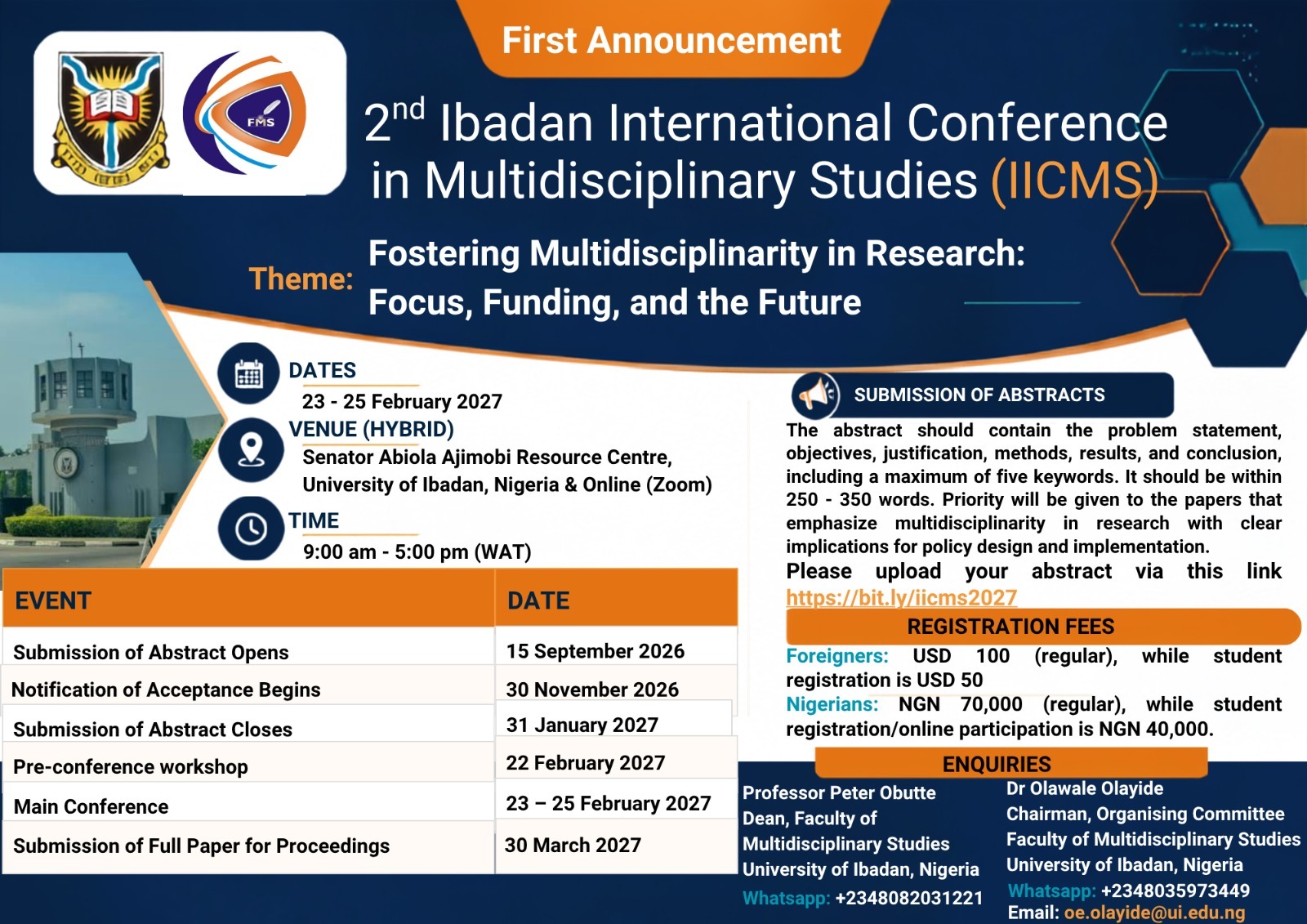
VENUE: Senator Abiola Ajimobi Resource Centre, Parry Road, Faculty of Multidisciplinary Studies, University of Ibadan, Nigeria & Online 

YouTube Link

https://youtube.com/@imagesinitiative1572?si=j0vW_jWov3Nw2Mym


Join Zoom Meeting

https://us02web.zoom.us/j/88281175503?pwd=3axJLEsY9ReOnFK6o1uoWZGKc44Z9G.1

Meeting ID: 882 8117 5503

Passcode: 895932


Gbogbonìṣe: A Reflection on Multidisciplinarity and Sustainability in Practice

This First Faculty Lecture of the Faculty of Multidisciplinary Studies, University of Ibadan, Nigeria delivered by Dr Olawale Emmanuel Olayide of the Department of Sustainability Studies, explores how multidisciplinarity, interdisciplinarity, and transdisciplinarity approaches are used to address complex sustainability challenges. Using personal experiences from his academic journey, the establishment of the Centre for Sustainable Development (CESDEV), and the creation of the Faculty of Multidisciplinary Studies at the University of Ibadan, Dr Olayide demonstrates the value of crossing disciplinary boundaries to solve real-world problems.

The lecture argues that sustainability challenges cannot be addressed by a single discipline. Multidisciplinarity brings together different disciplines, interdisciplinarity integrates their methods and knowledge, while transdisciplinarity extends collaboration beyond academia to include communities, practitioners, policymakers, and other stakeholders. These approaches are presented as essential pathways for producing practical and socially relevant solutions.

A central theme is sustainable development, defined as meeting present needs without compromising the ability of future generations to meet theirs. The lecture highlights the three core dimensions of sustainable development: social (people), economic (prosperity), and environmental (planet). Their intersections create equity, viability, and bearability, while true sustainable development occurs when all three dimensions are balanced.

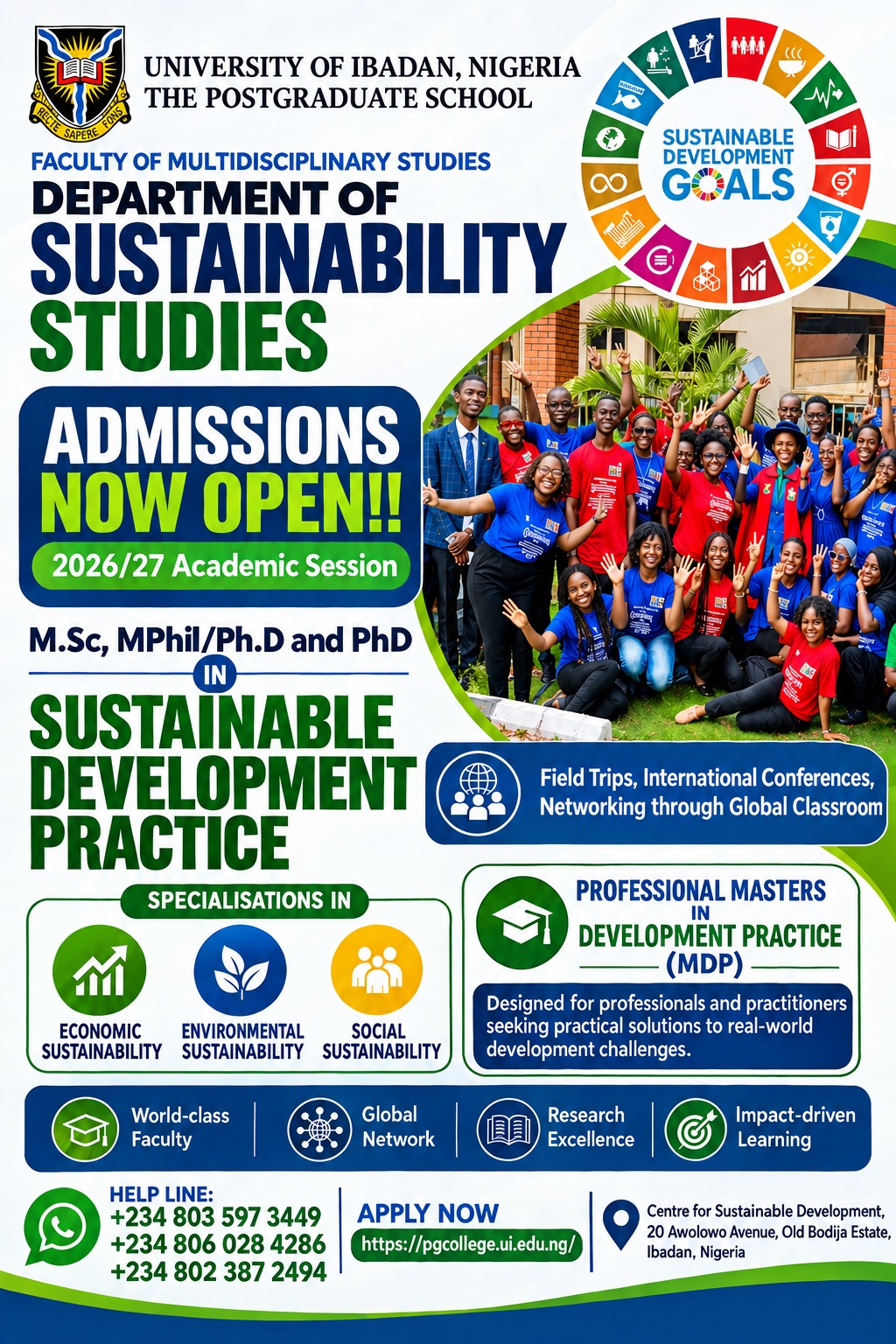
The Sustainable Development Goals (SDGs) are presented as the most widely recognised framework for operationalising sustainable development. The lecture explains the interdependence of the 17 SDGs, emphasising that progress in one goal can reinforce or constrain progress in others. Achieving the SDGs therefore requires integrated thinking, collaboration, and systems-based approaches.

Dr Olayide introduces the Yoruba concept of “Gbogbonìṣe” – a versatile individual with knowledge across multiple fields. He argues that sustainability professionals should embody this mindset by combining diverse knowledge, practical experience, and stakeholder engagement to create sustainable solutions.

The lecture concludes that sustainability is not a destination but a continuous journey requiring innovation, collaboration, inclusiveness, and long-term thinking. Multidisciplinary education and practice are therefore critical for building resilient societies and achieving sustainable development outcomes at local, national, and global levels.